Tonight, 4 March 2024, and tomorrow night, BBC Two will be showing Chris Packham’s documentary ‘Inside Our Autistic Minds’, which was first aired at the beginning of 2023. After I watched it last year, I wrote a social media post about some aspects of the series which I found highly problematic. This is what I wrote back then (with some very minor edits), and it’s all still very much relevant:
Last night I watched the second and final part of a new BBC documentary by Chris Packham which premiered last Tuesday. Although I liked a lot of it (actually *loved* a lot of it, and really like Chris’ way of presenting etc), there were some things that left me with mixed feelings… In this post, I will focus on the one main cause for my mixed emotions, and try to keep myself brief and to the point (not normally one of my strengths!):
Each episode of ‘Inside our autistic minds’ focuses on two different autistic young persons. In the first part, one of them is Murray, who’s nonspeaking and communicates mainly using spelling (by typing, for example in a text to speech app, or by pointing to letters on a printed letter board). It’s Murray & his parents you see in the first picture here.
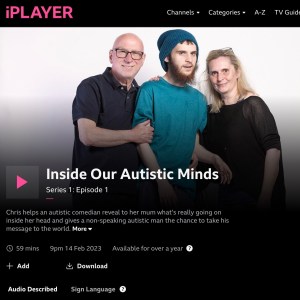
Murray expresses his thoughts about being autistic and struggling to communicate, and in the program his words are used to create a film, to help bring Murray’s message to the world. In his film, Murray talks about (and for) “nonverbal people” in positive ways, and says “We have a lot to say. Please listen to us.”
What Murray says – through typing and through the (also autistic) voice actor Harrison who reads out Murray’s words in the film – is inclusive of *all* nonspeaking autistics. He doesn’t say “some of us have something to say”…
However, disappointingly (from my perspective), Chris Packham says in his narration earlier in the program that “for a nonspeaking autistic person to have the intellect that Murray has, and the ability to type, is actually quite rare”. He goes on to say that most autistics who don’t speak also have severe learning disabilities, and he then visits a day centre for adults with such disabilities.
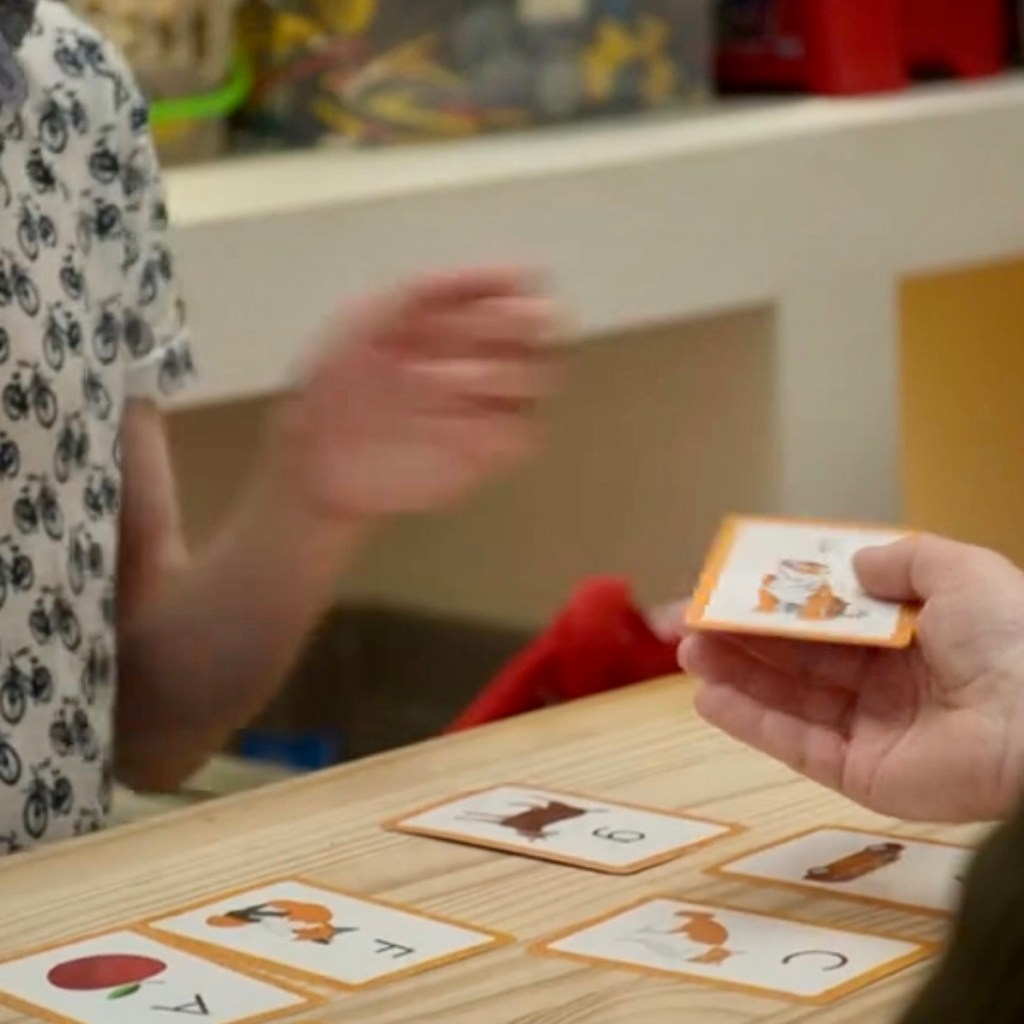
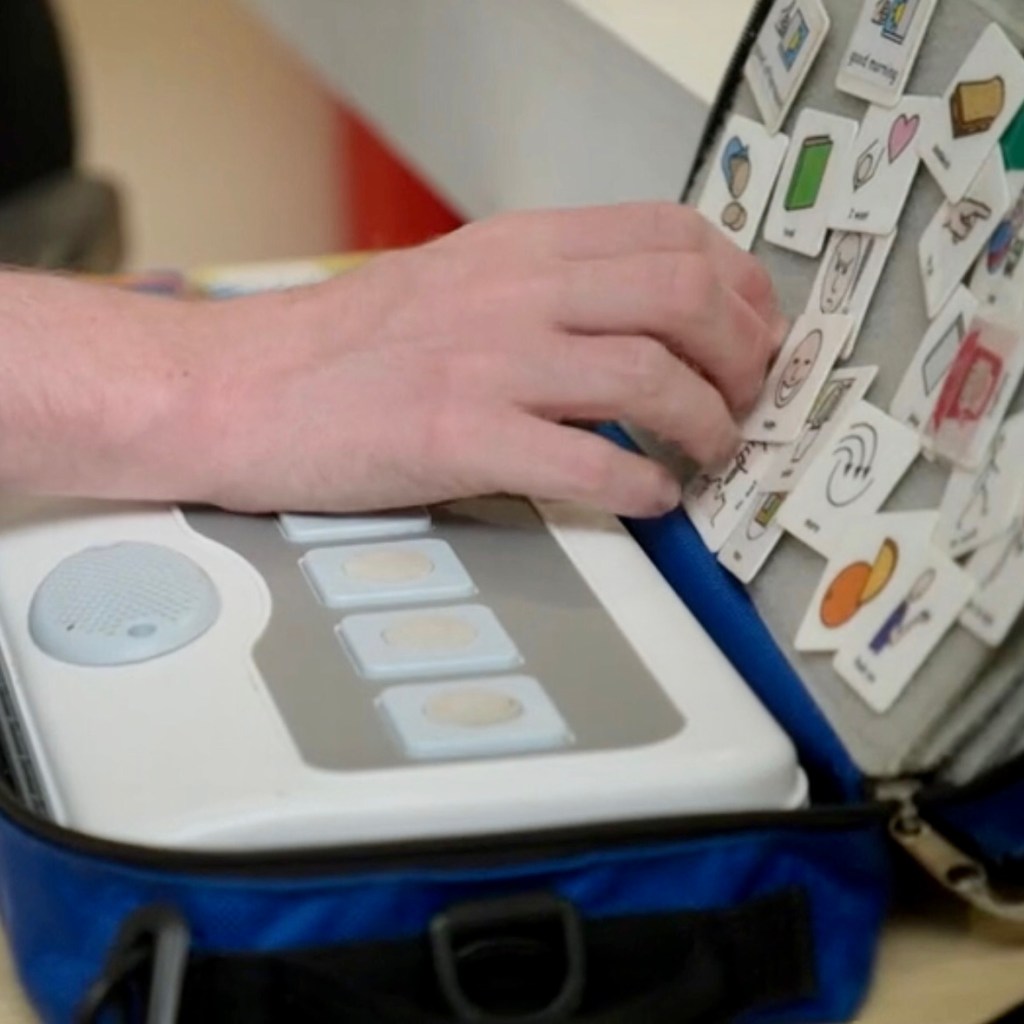
The two screen shots I’ve included here show means of ‘communication’ that were shown being used at the day centre. The first one is picture cards, and the man was simply asked ‘give me the bear’, ‘give me the tiger’ etc. I’d say this is more a test of the person’s understanding, than a means of communication. As a kind of game it’s not too bad, and it definitely involved some social interaction, but in no way was it helping the nonspeaking autistic man express his own thoughts, needs, opinions etc. I’ll admit, we did the same type of activity with my son when he was younger. In hindsight, that time could perhaps have been better spent, on more meaningful interactions in a more natural context. Either way, I felt quite upset seeing that young man, probably in his 20s, doing that activity and it being regarded as connection and communication…
The other screenshot I’ve included here is of a ‘mid tech’ type device, which speaks the word represented by the picture card you place on it. So with the cards you can see there, you could say things like “happy”, “I want”, “book”, “good morning” etc. Which is more than you can say by handing over a picture of a tiger, but it’s still a long way from Murray’s typing, which allows him to say whatever he wants to (I have some reservations about the format of how he types etc, but I’ll leave that aside for now).
I was so hoping to see *some* form of robust alternative communication in use at that day centre, but there was nothing… No AAC on iPad or similar, no PODD communication books, not even a core board. None shown in the documentary anyway. That made me so disappointed, and sad. I feel those adults were pretty much getting fobbed of with outdated picture cards. Has anyone ever believed in them and given them a proper chance and opportunity to learn how to better express their thoughts and wishes? I know my son’s ability to communicate isn’t a huge amount better yet than those young men’s, but he does have access to robust AAC and we are working on it.
I wonder how things might have been if Murray’s parents hadn’t been well educated, wealthy, and driven to find ways of helping their son communicate… Maybe he too would have been handing over picture cards at the day centre? I’m not saying every nonspeaking autistic person has the potential of being as eloquent as Murray. In fact, not many *speaking* people are as eloquent as that! But what I do think is that every nonspeaking person should be GIVEN THE CHANCE to express themselves, and to be listened to, the way Murray has been. They too should be given the chance to express what is inside *their* autistic minds.
As always, thank you for reading!
 Sensational Learning with Penguin
Hi Malin! Thank you for sharing your thoughts on Chris Packham’s documentary. It’s vital to highlight the need for accessible and robust communication methods for all nonspeaking autistics. Your perspective is invaluable. Did you receive a response?
LikeLiked by 1 person
Thank you Michael! I never did get any response from Chris Peckham or the production team, sadly.
I hope all is well with you and yours! x
LikeLiked by 1 person